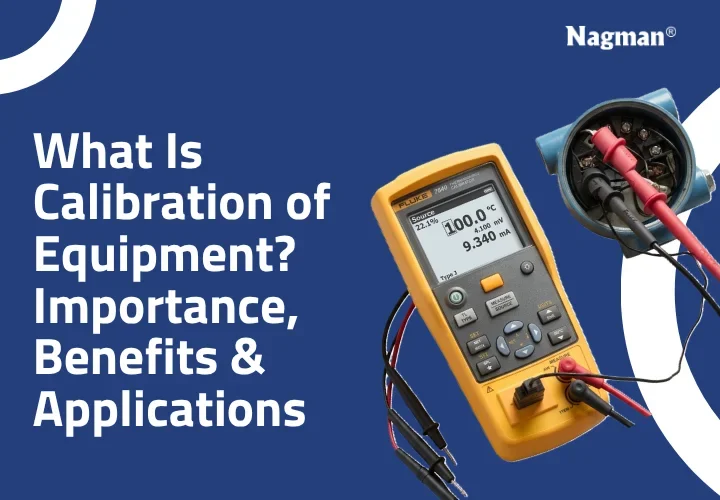
Precision is essential for any business that relies on accurate measurement, whether it’s a pharmaceutical company measuring active ingredients or a factory measuring the dimensions of a machine part. It thus becomes crucial to ensure that the equipment is calibrated to maintain accuracy and reliability throughout operations.
This blog provides a breakdown of what calibration of equipment means, why it is important in industries, and how it can help businesses.
What Is Calibration of Equipment?
To understand the advantages of calibration, we must know the meaning of industrial calibration.
Here is what this concept means:
Calibration is the process of comparing an instrument’s readings with those of a suitable reference standard to determine the measurement error and assess its performance.
If there is a difference, the instrument may be adjusted when appropriate, or the observed error can be documented and a correction factor applied where applicable.
Calibration may be required for a wide range of measuring instruments, including thermometers, pressure gauges, scales, flow meters, and analytical laboratory equipment, depending on their application and calibration requirements.
Why is Equipment Calibration Important?
The importance of calibration of equipment must not be overlooked, especially in industries that require accurate measurements or where small inaccuracies can have significant implications.
Here is what you should remember:
Instruments that are not properly calibrated can produce measurement errors, potentially affecting product quality, process control, and safety.
Compliance with regulatory standards is often a requirement for pharmaceuticals, healthcare, and manufacturing and requires regular calibration to meet standards and pass audits.
When the data is consistent and calibrated, the data generated carries more credibility for research, production, or safety monitoring.
Benefits of Equipment Calibration
In addition to compliance, regular calibration offers several practical benefits to businesses of all sizes.
The advantages are:
By ensuring consistent and accurate measurements, calibrated instruments minimise the risk of costly product rework or recall by maintaining the quality of the product.
Precise measurements facilitate good decision-making in production planning, research analysis or safety assessment.
Maintaining calibration records can be convenient when inspections or client audits are conducted, as it is easier to show that proper precautions were taken with records.
Calibration records can also help organizations monitor instrument performance over time and identify recurring measurement problems.
Which Industries Require Calibration for their Equipment?
Calibration is not limited to a single sector; it is important for multiple different industries that value accuracy in measurement.
Some of the industries that put great stock in calibration are:
Pharmaceutical and healthcare industries require accurate measurements for applications such as dosage control, testing, and diagnosis, where measurement reliability can be important for patient safety.
Manufacturing and engineering industries rely on accurate dimensional, pressure, temperature, and torque measurements to support product quality and process performance.
Food and beverage industries use accurate temperature, weight, pressure, and other measurements to support product quality and regulatory requirements.
Calibration of Laboratory Equipment
Calibration of laboratory equipment deserves particular attention, because laboratory instruments often require controlled and reliable measurements for research, testing, and analysis.
Here is why this area requires extra considerations:
Calibration is necessary for instruments like pH meters, spectrophotometers or analytical balances and needs to be done regularly to obtain reliable results.
Small errors in laboratory measurements may result in wrong conclusions, which may impact research findings or diagnoses.
There are many laboratories that need to follow strict internal protocols.
How Often to Calibrate Your Equipment
The recommended equipment calibration frequency varies; it does not follow a single fixed rule.
Some of these factors are:
- The manufacturer’s recommendations
- The frequency and intensity of instrument use
- Operating environment and conditions
- Required measurement accuracy
- Regulatory and industry requirements
- Previous calibration history and instrument performance
There is no universal calibration interval that applies to every instrument. Organizations should determine appropriate intervals based on the instrument, application, manufacturer recommendations, regulatory requirements, and historical calibration performance.
Frequently Asked Questions
- What is equipment calibration?
This is a process of comparing the readings of an instrument to a known standard to determine measurement error and assess its performance. Adjustments may be made when appropriate. - What is the importance of calibration of the equipment?
It ensures confidence in measurement results, helps businesses adhere to regulatory requirements, and minimises the risk of measurement errors impacting quality and safety. - What is the meaning of calibration of laboratory equipment?
It involves comparing laboratory instruments with suitable reference standards and assessing their measurement performance, such as pH meters and analytical balances, to support reliable results. - What is the frequency of calibration for equipment?
The calibration interval depends on the manufacturer’s recommendations, frequency of use, operating conditions, required accuracy, regulatory requirements, and previous calibration history. There is no universal one-year calibration interval for every instrument.
To Wrap Up
Quality, safety, and compliance are some aspects dependent on accurate measurements in all industries.
Calibration of equipment, thus, is used to uphold the reliability of instruments, operational efficiency, and end-user confidence.