Industrial operations depend on accurate temperature measurement. Any slight fluctuation in temperature can affect product quality and the safety and efficiency of operations. That is why industries across sectors rely on calibration tools known to be accurate. The dry block calibrator is one of the most reliable tools for calibrating instruments for temperature measurement.
In this blog, we discuss the meaning of dry block calibrators, how they work, and their popularity in industrial testing.
What is a Dry Block Calibrator?
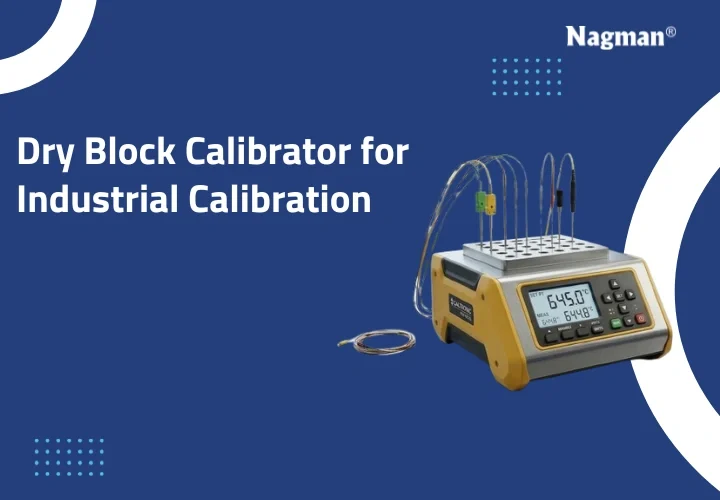
Dry block calibrators are handheld temperature calibration instruments used to perform tests and verify the accuracy of temperature sensors, including thermocouples, RTDs, and temperature probes. It is extensively used in sectors where temperature control is a major factor in ensuring operational efficiency and safety.
Dry block temperature calibrators differ from conventional liquid bath calibrators, in which the solid metal block is heated or cooled to specific temperatures. Instead, this metal block has small holes into which sensors are inserted, allowing technicians to compare the sensor readings with the reference temperature produced by the temperature calibrator.
How a Dry Block Temperature Calibrator Works
The calibrator has metal block holes that are precision-drilled for inserting temperature sensors.
The working principle of a dry block temperature calibrator is usually as follows:
- The machine heats or cools the metal block to the required reference temperature.
- Sensors or probes are inserted into the block’s calibration wells.
- The temperature stabilises at the desired temperature.
- The technician contrasts the sensor value and the reference temperature shown on the calibrator.
- Any deviation in the reading values indicates that the sensor may need adjustment or recalibration.
Applications of the Dry Block Calibrator in the Calibration Laboratory
In professional calibration laboratories, it is commonly used to check the accuracy of temperature measurement devices.
Dry block calibrating instruments are used in industries in a number of ways, which include:
- Thermocouple calibration in industrial equipment.
- Testing of RTD sensors used in manufacturing processes.
- Checking of temperature probes utilised in the laboratory.
- Temperature monitoring equipment calibration in pharmaceutical manufacturing.
- Checking equipment in food processing and cold-chain control.
Dry Block Calibrator Price and Selection Guide
When choosing the right dry block calibrators, the needs in the industry must be considered carefully.
The dry block calibrator price depends on a number of factors, which include:
- Temperature range capability.
- Heating and cooling speed
- Stability and calibration accuracy.
- Number of sensor wells available
- Features like portability and digital interface.
Role of Temperature Calibrator in Industrial Testing
Dry block calibrators are preferred over other types of temperature calibrator instruments because they are easy to use and highly precise. It assists technicians in confirming the functionality of sensors used in industrial equipment.
Pharmaceuticals, petrochemicals, food processing, and power generation are sectors that extensively use dry block calibrator systems to maintain equipment accuracy.
Difference Between Dry Block Calibrator and Process Calibrators
Dry block calibrators are specifically designed for temperature calibration. It provides a controlled temperature environment for testing temperature sensors. This makes it ideal for checking thermocouples and RTDs.
Conversely, a process calibrator is a versatile instrument used to measure and simulate electrical signals such as voltage, current, and resistance. Although process calibrators can provide temperature functions, they do not typically offer the same degree of temperature stability as dry block calibrators.
Importance of Pressure Gauge Calibration in Industries
Although measuring temperature is a necessity, pressure measurement systems in a given industry must also be accurate. This is where calibrating pressure gauges becomes equally crucial. Pressure gauges are commonly used in manufacturing industries, pipelines, chemical processing plants and power generation stations.
Regular pressure gauges calibration of ensures that the instruments provide accurate readings and helps prevent operational risk.
Conclusion
Calibration must be performed accurately to ensure reliable industrial processes. The dry block calibrator has become one of the most widely used tools for checking temperature readings because it is precise, portable, and easy to operate. Together with routine calibration of pressure gauges, proper temperature calibration guarantees enhanced safety, operational efficiency and consistently high-quality products across industrial sectors.