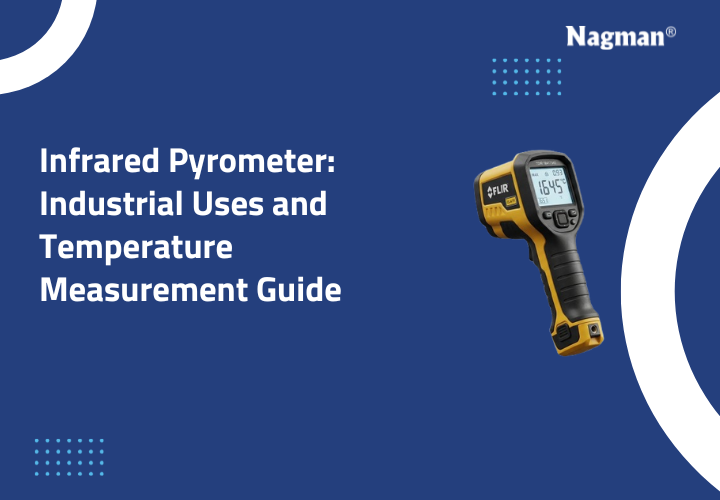
In many industrial processes, accuracy and safety are critical factors. In high-temperature situations or when a target is moving or inaccessible, standard contact thermometers can be inconvenient or dangerous. Here comes the role of infrared pyrometers. In this blog, we understand what a pyrometer is, how an infrared pyrometer works, its applications, and its use across different industries.
What is a Pyrometer?
A pyrometer is a specialised tool that helps measure very high temperatures without needing to come into direct contact with the object under measurement. In most industrial environments where surfaces are hot, unsafe, or inaccessible, a pyrometer can be used to measure temperature, making it safe and efficient.
Pyrometers are usually employed in industries where temperature control is essential. A pyrometer is used to measure furnace and molten-metal temperatures, as well as temperatures in manufacturing equipment and other high-heat processes.
Infrared Pyrometer Working Principle
All objects emit thermal radiation according to their temperature. This radiation is recorded by infrared pyrometers via an optical system and directed to a detector. The detector converts the energy of the radiation into an electrical signal, which is then processed and presented as a temperature reading.
The more the temperature rises, the more the infrared radiation increases. By analysing this radiation, the device can determine the temperature without touching the object.
What is a Pyrometer Used to Measure?
In industrial environments, a pyrometer is used to measure the temperature of:
- Molten metals in foundries and steel plants.
- Industrial kilns and furnaces.
- Glass manufacturing equipment.
- Ceramic processing units
- Hot rolling mills and forging machines.
Use of Pyrometer in Industrial Applications
Pyrometers are widely used in industries where temperature control directly affects product quality and operational efficiency.
Some of the major industrial applications are:
Steel and Metal Industry: Infrared pyrometers are used in metal processing plants to verify that molten metal temperatures in smelting, casting, and forging processes are within acceptable limits.
Glass Manufacturing: Glass manufacturing is extremely hot. To control glass quality, a pyrometer is used to monitor furnace temperatures.
Ceramics Industry: Temperature control is essential in ceramic kilns. Manufacturers can use pyrometers to accurately monitor heating processes.
Power Plants: Pyrometers are used in thermal power plants to measure boiler and turbine temperatures, which are essential for efficient energy production.
Food Processing and Packaging: Certain high-temperature operations in food production also rely on infrared sensors to accurately measure heat.
Infrared Pyrometer Temperature Range
Generally, the temperature range of infrared pyrometers varies by model and industry needs. Most devices measure temperature between approximately -50 °C and well above 3000 °C.
The extended infrared pyrometer temperature range makes the device suitable for numerous applications in industries such as metallurgy, ceramics, glass production, and high-temperature production processes.
Infrared Pyrometer Price and Buying Factors
When it comes to buying infrared pyrometers, their prices vary with factors such as accuracy, measurement range, and product quality.
The price of infrared pyrometers depends on the following:
- Temperature measurement.
- Resolution and accuracy of optical detectors.
- Response time and sensitivity of the sensor.
- Durability for industrial environments.
- Calibration features and brand reputation.
Advantages of Using an Infrared Pyrometer
There are various advantages of using infrared pyrometers, particularly in industries where safety and efficiency are required.
The following are some of the significant benefits:
- Non-contact temperature measurement
- Safe operation in extremely high temperatures.
- Fast and accurate readings
- Ability to measure moving or rotating objects.
- Minimised the chance of equipment damage.
Why an Infrared Pyrometer is Essential for High-Temperature Measurements
Accurate temperature measurement is important for preserving product quality and ensuring safe working conditions in industry. Since a pyrometer can measure temperatures without contact, industries can monitor processes in real time without disruption. Remote measurements of high temperature also enhance the safety of technicians and engineers in high-risk areas.
Conclusion
An infrared pyrometer has become one of the most essential devices for measuring high temperatures in modern industries. Non-contact measurement, fast response time and accurate readings, the infrared pyrometer is a smart engineering solution to every thermal engineering challenge.