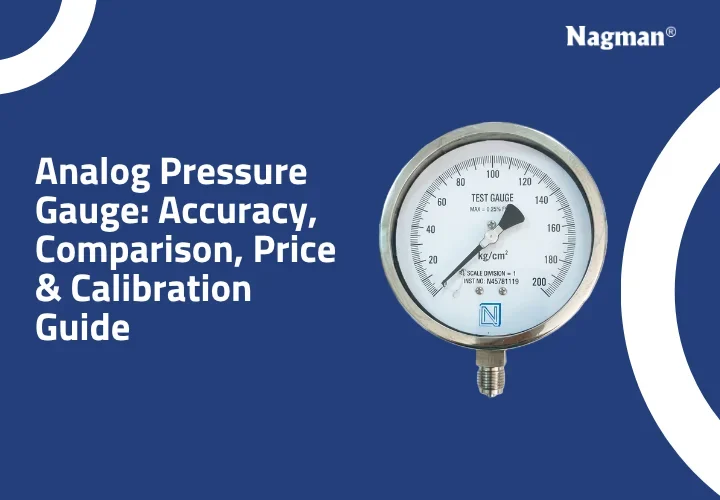
One of the most popular tools for measuring pressure in automobile air systems and industries is an analog pressure gauge. It is simple and reliable to use. It allows users to precisely check pressure levels in both factories and garages without batteries or digital systems.
The analog air pressure gauge is still preferred by many industries today due to its low maintenance requirements and long lifespan.
Introduction
An analog pressure gauge is a mechanical instrument that uses a dial display and a needle to measure pressure. A circular scale displays the pressure value.
These are widely used because they are inexpensive, simple to install, and appropriate for harsh environments.
How an Analog Pressure Gauge Works
An analog pressure gauge is powered by internal mechanical components. A Bourdon tube mechanism is used by most gauges. The tube expands slightly when pressure enters the gauge. This movement moves the dial’s needle, displaying the pressure reading.
The measurement is shown in units such as kg/cm², bar, or psi. Analog gauges are very reliable in industrial settings due to their simple design.
Analog Pressure Gauge Accuracy
The calibration size and quality of an analog pressure gauge all affect its accuracy. The accuracy of most standard gauges is between ±1 and ±2% of full scale.
The Analog pressure gauge accuracy is affected by several variables such as temperature, wear over time and vibration. To obtain accurate readings, the right pressure range must be selected.
Analog Pressure Gauge vs Digital
Depending on the application, both kinds have benefits. Analogue pressure gauges are easy to use, durable and do not require power. Rough industrial settings are perfect for it.
Digital gauges, on the other hand, offer extremely accurate readings and sophisticated features like data storage. typically less expensive and simpler to maintain than digital ones.
Analog vs Digital Pressure Gauge – Key Differences
This is what an analog gauge provides.
- Easy readability
- No battery is needed.
- Extended operational life.
- Cheaper upkeep.
A digital gauge provides the following benefits.
- Improved accuracy.
- Digital exhibit.
- Advanced monitoring tools.
- Improved recording of data.
Pressure Gauge with Analog Output
Process industries make extensive use of pressure gauges with analog output. These gauges can connect with monitoring devices and control systems. They supply constant-pressure signals for industrial automation.
For seamless monitoring and system control, industries like manufacturing, chemical processing and oil and gas frequently use pressure gauges with analog outputs.
Analog Pressure Gauge Price in India
The brand size, material and pressure range all affect how much an analog pressure gauge costs in India. Basic gauges are reasonably priced, but industrial-grade models are more expensive because of their superior accuracy and construction.
While heavy-duty industrial gauges can cost several thousand rupees, a small analog tyre pressure gauge might only cost a few hundred.
Instead of just selecting the least expensive option, buyers should take quality, accuracy and durability into account when examining the price of analog pressure gauges.
Analog Pressure Gauge Calibration
Maintaining accurate pressure readings requires calibration of analog pressure gauges. Over time, mechanical wear or environmental factors may cause gauges to display inaccurate readings.
A standard reference instrument is used to compare the gauge reading during the calibration of an analog pressure gauge. Adjustments are made to restore accuracy if there is a discrepancy.
In order to maintain correct operation, many industries plan for periodic calibration of analog pressure gauges.
Applications of Analog Pressure Gauge
- Analog Air Pressure Gauge – Pneumatic tools, HVAC systems and compressors frequently use analog air pressure gauges. It guarantees safe system operation and helps in air pressure monitoring.
- Analog Tire Pressure Gauge – Vehicle tyre pressure is frequently checked using an analog tire pressure gauge. Maintaining proper tyre pressure increases tyre life, safety and fuel efficiency.
How to Choose the Right Analog Pressure Gauge
It depends on several factors
- Pressure range.
- Requirements for accuracy.
- Size of the dial.
- Material calibre.
- Working conditions.
Because stainless steel gauges are resistant to corrosion, they are frequently chosen for industrial applications. Before making a purchase, users should take into account the accuracy and calibration requirements of analog pressure gauges.
Conclusion
One of the most reliable tools for measuring pressure in automobiles and industries is still an analog pressure gauge. Because of its affordability, durability and simple design, it can be used in a variety of settings.
Users continue to select analog gauges due to their dependable performance, whether they are comparing Analog vs digital pressure gauge or looking up the cost of analog gauges.