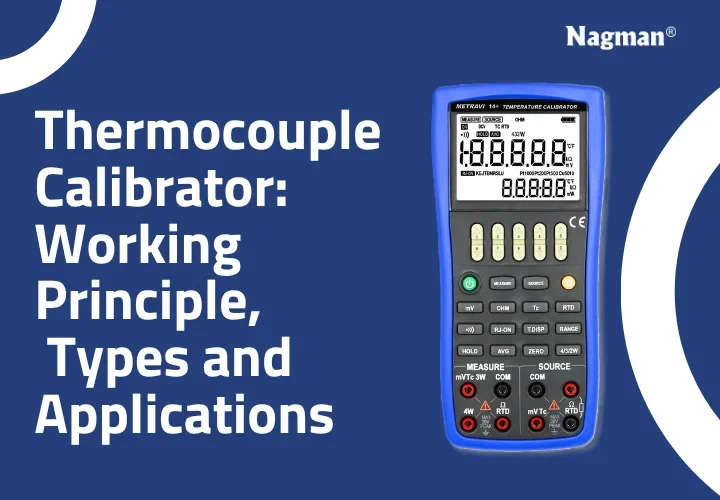
A Thermocouple Calibrator is a test instrument used to measure, simulate, and verify thermocouple signals. It helps technicians check the performance of thermocouples, temperature transmitters, indicators, controllers, and other temperature measurement devices.
Thermocouples are widely used in industrial processes. Over time, sensor ageing, harsh conditions, wiring problems, and instrument drift can affect measurement accuracy. Thermocouple Calibration helps identify these errors and maintain reliable temperature measurements.
What Is a Thermocouple Calibrator?
A Thermocouple Calibrator generates or measures signals related to different thermocouple types. A technician can use a known signal or reference value to check whether the connected instrument provides the expected temperature reading.
In simple terms, it is a reference instrument used to test the accuracy of a thermocouple measurement system.
Depending on the model, the instrument may provide functions such as thermocouple simulation, signal measurement, cold junction compensation, and support for multiple thermocouple types.
For industrial applications, choose based on the required sensor type, temperature range, accuracy, and calibration method.
Explore Nagman Instruments’ Temperature Calibrators
How Does It Work?
The Thermocouple Calibrator Working Principle is based on the electrical signal a thermocouple produces.
A thermocouple consists of two different metal wires joined together. When a temperature difference exists between the measuring junction and the reference junction, it produces a small voltage.
During testing, the calibrator can generate a known signal that represents a particular temperature. The connected instrument receives this signal and displays a temperature value.
The technician then compares the displayed value with the expected or reference value.
Known signal → Test instrument → Temperature reading → Compare → Identify error
This lets you check a temperature measurement system without always exposing the sensor to the actual process temperature.
Thermocouple Calibrator Types
Different thermocouple calibrator types meet different testing requirements.
Thermocouple Simulator
A thermocouple simulator generates a signal equivalent to the output of a thermocouple. It can test temperature indicators, controllers, transmitters, and input channels.
Thermocouple Measurement Calibrator
This type measures the signal produced by a thermocouple and displays the corresponding temperature. It is useful for checking sensor and measurement-system performance.
Multifunction Calibrator
A multifunction calibrator can handle thermocouple signals along with other electrical or process signals. It can be useful when technicians perform several calibration tasks with one instrument.
The suitable option depends on the required accuracy, thermocouple types, measurement range, functions, and intended use.
What Equipment Is Used for Thermocouple Calibration?
Thermocouple Calibration Equipment can include a calibrator, temperature source, reference thermometer, dry block calibrator, sensor, and suitable connecting accessories.
The equipment required depends on the calibration method and accuracy level.
For applications that require a controlled temperature source, a Dry Block Temperature Calibrator can provide stable temperature points for sensor testing.
View Nagman’s Dry Block Temperature Calibrators
Using suitable reference equipment is important because calibration results depend on the complete measurement setup.
Thermocouple Temperature Calibration Process
Thermocouple Temperature Calibration involves comparing the device-under-test reading with a known reference value.
A basic process includes:
- Identify the thermocouple type and measurement range.
- Select suitable calibration equipment.
- Connect the sensor or instrument correctly.
- Apply the required temperature or simulated signal.
- Allow the reading to stabilize.
- Compare the test reading with the reference.
- Record the measurement error.
- Adjust the instrument if required.
- Repeat the test to confirm the result.
- Document the calibration results.
The exact procedure may vary depending on the equipment, application, accuracy requirements, and applicable calibration procedure.
Where Is It Used?
Thermocouple calibrator applications span many industries where temperature measurement is part of process control, testing, or maintenance.
Manufacturing
Used to verify temperature instruments involved in production and process control.
Process Industries
Useful for checking temperature transmitters, indicators, controllers, and thermocouple input channels.
Calibration Laboratories
Laboratories use temperature calibration equipment to compare sensors and instruments with known reference values.
Maintenance and Troubleshooting
Portable instruments can help technicians identify temperature measurement errors during field maintenance.
Testing and Research
They can support applications where temperature readings need to be verified against a reference.
Why Is Thermocouple Calibration Important?
Thermocouples can develop measurement errors because of ageing, contamination, harsh environments, wiring issues, or connected instrument drift.
Regular Thermocouple Calibration helps detect these changes and provides greater confidence in temperature readings.
It can support:
- Accurate temperature measurement
- Process quality control
- Sensor troubleshooting
- Detection of measurement drift
- Calibration record maintenance
- Reliable process decisions
Base calibration intervals on the application, operating conditions, required accuracy, and previous calibration results.
How to Choose the Right Instrument?
Before purchasing a Thermocouple Calibrator, consider the following:
- Thermocouple type: Make sure it supports the required sensor types.
- Accuracy: Match the instrument accuracy to your application.
- Temperature range: Check that the required testing range is covered.
- Functions: Decide whether you need simulation, measurement, or both.
- Portability: Field technicians may benefit from a compact, battery-operated instrument.
- Application: Consider whether it will be used in a laboratory, plant, or maintenance environment.
If you need help selecting equipment, first review the required sensor type, range, accuracy, and calibration method.
Explore Nagman Instruments’ Temperature Calibration Solutions
Frequently Asked Questions
- What is a Thermocouple Calibrator used for?
A thermocouple calibrator simulates or measures thermocouple signals and verifies the performance of temperature measurement instruments. - How does thermocouple calibration work?
A known temperature or thermocouple-equivalent signal is applied to the device under test. Its reading is compared with a reference value to identify measurement error. - What equipment is needed for thermocouple calibration?
Depending on the application, the setup may include a calibrator, temperature source, reference thermometer, dry block calibrator, and suitable accessories. - How often should thermocouples be calibrated?
No single interval fits every application. Frequency depends on operating conditions, required accuracy, previous calibration results, and quality procedures.
Temperature Calibration Solutions from Nagman Instruments
Reliable temperature measurement starts with suitable calibration equipment and a proper testing method. Consider the required sensor type, temperature range, accuracy, and application before selecting an instrument.
Nagman Instruments provides calibration and test instrumentation for industrial measurement applications, including temperature calibration solutions.
If you are looking for suitable equipment for Thermocouple Calibration, explore Nagman Instruments’ temperature calibration solutions or contact the Nagman team to discuss your application requirements.