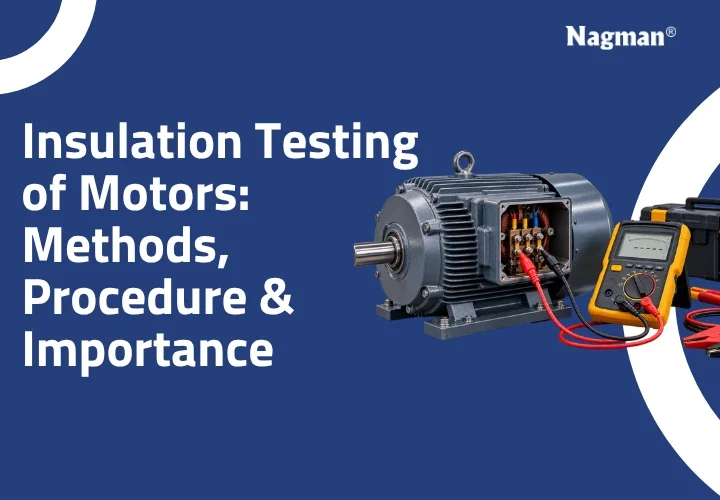
Insulation testing of motors is the process of measuring the electrical resistance of a motor’s insulation to identify deterioration, moisture, contamination, or potential insulation failure. It is an important preventive maintenance practice for industrial motors because it can help detect problems before they lead to electrical faults, unexpected downtime, or equipment damage.
An insulation tester or insulation resistance tester is commonly used for this purpose. The test results can help maintenance teams assess the condition of motor windings and monitor changes over time.
What Is Insulation Testing of Motors?
Insulation testing of motors measures the resistance offered by the insulation between the motor windings and ground, or between selected windings depending on the testing method.
Good insulation provides high resistance to unwanted current flow. A low or declining insulation resistance reading may indicate moisture, contamination, aging, overheating, or physical damage.
Motor insulation testing is commonly relevant to motors used in manufacturing plants, pumps, compressors, HVAC systems, power equipment, and other industrial applications.
The measured results should always be interpreted according to the motor manufacturer’s recommendations, applicable standards, test conditions, and equipment specifications.
Why Is Motor Insulation Testing Important?
Motor insulation can deteriorate due to heat, humidity, vibration, dust, chemicals, electrical stress, and long-term operation. If deterioration is not identified, it can eventually contribute to winding faults and motor failure.
Regular testing can help:
- Identify insulation deterioration at an early stage
- Reduce unexpected motor failures
- Support preventive maintenance
- Improve electrical safety
- Detect moisture and contamination
- Track insulation condition over time
- Reduce costly equipment downtime
For critical industrial motors, maintaining historical test records is particularly useful because changes in readings can provide valuable information about insulation condition.
Need an Insulation Testing Solution?
Choosing the right test equipment is important for obtaining reliable and repeatable measurements. Nagman Instruments provides test and measurement solutions for industrial applications.
Contact Nagman Instruments to discuss the right insulation testing equipment for your motor testing requirements.
How Is a Motor Insulation Test Performed?
The exact procedure depends on the motor design, manufacturer instructions, applicable standards, and test equipment. A typical insulation testing of motors procedure includes the following steps:
1. Isolate the Motor
Disconnect the motor from its power supply and make sure it cannot be energized during testing. Follow appropriate electrical safety procedures before starting the test.
2. Inspect the Motor
Check the motor terminals, cables, windings, and visible insulation for signs of moisture, dirt, overheating, cracks, or other damage.
3. Select the Test Equipment
An insulation tester applies a controlled DC test voltage and measures the resulting insulation resistance. The appropriate test voltage should be selected according to the motor manufacturer’s recommendations and applicable testing requirements.
4. Connect the Tester
Depending on the motor configuration, measurements may be taken between the winding and ground or between individual windings. Correct connections are essential for obtaining meaningful results.
5. Apply the Test Voltage
Apply the selected test voltage for the required test duration. The instrument measures the resistance of the motor insulation during the test.
6. Record the Results
Record the insulation resistance together with the test voltage, temperature, test duration, and other relevant conditions. Comparing results with previous readings can help identify changes in insulation condition.
7. Discharge the Motor
After completing the test, safely discharge the motor windings before reconnecting or handling the equipment.
Insulation Test for a 3-Phase Motor
An insulation test for a 3-phase motor generally involves checking insulation between the windings and ground and, depending on the test method, between individual phases.
The exact connection method depends on the motor configuration and manufacturer’s instructions. Each phase should be tested carefully, and the results should be recorded for future comparison.
A significant difference between phase readings or a declining trend may indicate that additional inspection or testing is required.
What Is a Megger Tester and How Does It Work?
A Megger tester, commonly referred to as an insulation resistance tester, is designed to measure high resistance in electrical insulation.
The Megger tester working principle involves applying a DC test voltage to the insulation and measuring the resulting leakage current. The instrument uses these measurements to determine insulation resistance.
Modern insulation testers may offer features such as selectable test voltages, digital readings, timed tests, data storage, and other measurement functions.
Insulation Tester Diagram and Connections
An insulation tester diagram generally shows the tester connected between a motor winding and the motor frame or ground. For a 3-phase motor, the connection arrangement depends on whether the test is being performed phase-to-ground or between phases.
Because motor configurations and test requirements can vary, technicians should follow the manufacturer’s connection instructions and relevant safety procedures instead of relying only on a generic diagram.
How Often Should Motor Insulation Be Tested?
There is no single testing interval that applies to every motor. The frequency can depend on:
- Motor operating conditions
- Operating hours
- Temperature and humidity
- Environmental conditions
- Motor criticality
- Maintenance history
- Manufacturer recommendations
- Previous insulation test results
For important industrial motors, periodic testing and consistent record-keeping can help maintenance teams identify changes before they become serious problems.
Best Practices for Motor Insulation Testing
For reliable and repeatable results:
- Use a suitable and properly maintained test instrument.
- Follow the motor manufacturer’s recommendations.
- Select the appropriate test voltage.
- Record test conditions and results consistently.
- Compare current readings with historical results.
- Consider environmental and temperature conditions when evaluating results.
- Ensure the motor is completely isolated before testing.
- Safely discharge the windings after testing.
For a broader overview of electrical and electronic measuring equipment, you can also explore Top 12 Electrical and Electronic Measuring Instruments.
Choose the Right Testing Equipment
Accurate testing depends not only on the test procedure but also on selecting suitable measurement equipment for the application. The required test voltage, measurement range, accuracy, motor type, and testing environment should all be considered before selecting an insulation resistance tester.
Looking for reliable test and measurement equipment for industrial applications? Contact Nagman Instruments for suitable solutions based on your testing requirements.
Conclusion
Insulation testing of motors is an important preventive maintenance practice for identifying potential insulation problems before they develop into serious electrical failures. Using a suitable insulation tester, maintenance teams can measure insulation resistance and monitor changes in motor condition over time.
For 3-phase and other industrial motors, proper isolation, suitable test voltage, correct connections, accurate recording, and appropriate interpretation of results are essential. Regular testing combined with planned maintenance can support safer, more reliable motor operation.
If you need guidance on selecting suitable insulation testing equipment, Nagman Instruments can help you identify a solution based on your industrial measurement requirements.