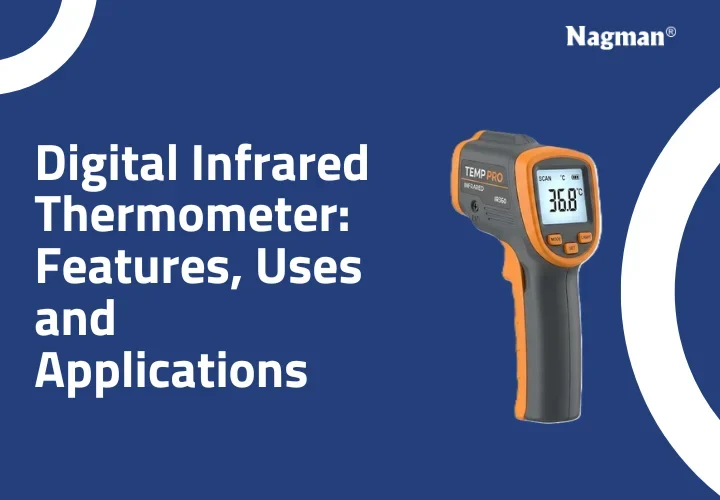
A Digital Infrared Thermometer is a non-contact temperature measurement instrument that detects infrared radiation from an object and converts it into a temperature reading. It allows users to measure surface temperature quickly without touching the target.
These instruments are used in manufacturing, electrical maintenance, food processing, HVAC, automotive service, laboratories, and other applications. The right instrument depends on factors such as temperature range, accuracy, measurement distance, target surface, and operating conditions.
What Is a Digital Infrared Thermometer?
A digital infrared thermometer measures the thermal energy naturally emitted by an object. An infrared sensor detects this energy and converts it into an electrical signal. The instrument processes the signal and displays the temperature on a digital screen.
Since measurement does not require physical contact, it is useful for hot surfaces, moving equipment, difficult-to-reach areas, and applications where contact measurement is not practical.
For industrial use, users should check the specified temperature range, accuracy, optical resolution, emissivity settings, and environmental limits before selecting an instrument.
How Does It Work?
The working principle is based on infrared radiation. Objects emit infrared energy according to their temperature. The instrument collects this radiation through its optical system and directs it to an infrared detector.
The detector converts the radiation into an electrical signal. Internal electronics then process the signal and display the estimated surface temperature.
Measurement results can be affected by:
- Distance between the instrument and target
- Surface material and emissivity
- Ambient temperature
- Measurement angle
- Target size
- Optical resolution
- Calibration condition
Following the manufacturer’s operating instructions is important when accurate measurements are required.
Key Features
Modern infrared temperature instruments are available with different features for different applications.
Non-Contact Measurement
The instrument can measure a surface without physical contact. This is useful for hot equipment, moving components, and areas where touching the target could create a safety or contamination risk.
Digital Display
The reading appears directly on a digital screen, making it easy to observe and record the measured value.
Adjustable Emissivity
Some industrial models allow emissivity adjustment. This can be useful when measuring different surface materials because emissivity affects infrared measurement.
Wide Temperature Range
Industrial models may support much higher or wider temperature ranges than instruments designed for general-purpose use. The required range should always match the application.
Laser Targeting
Some models include a laser pointer to help identify the approximate measurement location. The laser is only a targeting aid and does not perform the temperature measurement.
Data and Alarm Functions
Advanced instruments may include high-temperature alarms, data storage, or other features that support inspection and maintenance activities.
Digital Infrared Thermometer Uses
The Digital Infrared Thermometer Uses vary across industries because the instrument provides quick surface temperature measurements without direct contact.
Manufacturing
Technicians can inspect motors, bearings, machinery, electrical cabinets, and other equipment. Unusual temperature differences can indicate areas that may need further investigation.
Electrical Maintenance
It can be used to check electrical panels, connections, switches, and components for abnormal heating. Temperature differences can help technicians identify potential problems before carrying out detailed inspection.
Food Processing
Temperature checks are important in food processing and storage. Non-contact measurement can be useful for suitable surface and process checks when the instrument is appropriate for the application.
HVAC Systems
Technicians can inspect temperature differences across pipes, ducts, cooling components, and other accessible surfaces during maintenance.
Automotive Service
The instrument can support temperature checks on engines, brakes, cooling systems, bearings, and other vehicle components.
Laboratories
Laboratories may use infrared measurement for specific testing and monitoring tasks where surface temperature measurement is suitable.
Digital Infrared Thermometer Accuracy
Digital Infrared Thermometer Accuracy depends on how the instrument is used as well as its stated specification.
Emissivity is an important factor. Different materials emit infrared energy differently. Shiny or reflective surfaces can be more difficult to measure accurately than suitable matte surfaces.
Distance is another consideration. The optical field of view determines the area being measured. If the target is too small or the measurement distance is unsuitable, the reading may not represent the intended surface.
Other factors include:
- Ambient conditions
- Target size
- Surface condition
- Measurement angle
- Sensor condition
- Calibration status
For critical measurements, users should follow the manufacturer’s recommended procedure and maintain an appropriate calibration schedule.
Non-Contact Digital Infrared Thermometer
A Non Contact Infrared Digital Thermometer measures temperature without touching the target.
This makes it useful for hot, moving, contaminated, or difficult-to-access surfaces. It can also reduce the need for physical contact during routine inspections.
However, non-contact measurement does not automatically guarantee accuracy. Correct distance, emissivity, target selection, and instrument specifications still need to be considered.
Handheld Digital Infrared Thermometer
A Handheld Digital Infrared Thermometer is designed for portable temperature inspections.
Technicians can carry it around a facility and check different equipment and measurement points. This makes handheld instruments useful for preventive maintenance and routine inspections.
Before selecting one, consider:
- Temperature range
- Accuracy
- Optical resolution
- Emissivity adjustment
- Response time
- Environmental conditions
- Calibration requirements
For industrial applications, measurement performance should be considered along with portability and ease of use.
Digital Infrared Thermometer Gun
A Digital Infrared Thermometer Gun is a handheld instrument commonly designed in a pistol-style format. It allows technicians to take quick point-and-measure temperature readings.
Many models include a trigger-operated measurement function, digital display, and laser targeting. However, users should understand the instrument’s optical specifications because the laser point does not always represent the complete measurement area at every distance.
How to Choose the Right Instrument
The right temperature measuring instrument depends on the application, not just the purchase price.
Before selecting a model, consider:
- Temperature range: The instrument should cover the expected temperature of the target.
- Accuracy: Check the stated accuracy and the conditions under which it applies.
- Optical resolution: This is important when measuring small targets from a distance.
- Emissivity: Adjustable settings can be useful when measuring different materials.
- Response time: Faster response can be helpful during moving equipment inspections.
- Operating environment: Check whether the instrument is suitable for the temperature, dust, moisture, or other conditions at the site.
- Calibration support: For critical measurements, calibration and measurement traceability should be considered.
Why Is Calibration Important?
Temperature measurement can become unreliable when an instrument changes performance over time or is used outside its specified conditions.
Calibration compares an instrument’s readings with a suitable reference under defined conditions. It helps identify measurement deviations and provides greater confidence in the results.
For industries where temperature measurements influence product quality, process control, or maintenance decisions, an appropriate calibration program is an important part of measurement management.
Nagman Instruments provides calibration and measurement solutions for industrial applications. The suitable calibration method depends on the instrument, temperature range, required accuracy, and application.
Frequently Asked Questions
- What is a digital infrared thermometer?
It is a non-contact instrument that detects infrared radiation from an object and converts it into a digital temperature reading. - Where is it used?
It is commonly used in manufacturing, electrical maintenance, HVAC, automotive service, food processing, laboratories, healthcare, and other applications involving surface temperature measurement. - How accurate is infrared temperature measurement?
Accuracy depends on the instrument specification, emissivity, measurement distance, target size, ambient conditions, measurement technique, and calibration status. - Is a handheld model suitable for industrial use?
A handheld model can be suitable when its temperature range, accuracy, optical resolution, environmental rating, and other specifications match the industrial application. - Does an infrared thermometer need calibration?
For applications where temperature accuracy is important, calibration should be performed according to the instrument’s requirements, usage, and applicable quality procedures.
Conclusion
A digital infrared thermometer provides a fast way to measure surface temperature without physical contact. Its usefulness depends on selecting an instrument that matches the required temperature range, accuracy, optical characteristics, and operating environment.
For industrial applications, correct measurement technique and regular calibration are also important for maintaining reliable results.
Need help choosing the right temperature measurement or calibration solution? Contact Nagman Instruments to discuss your specific application and measurement requirements.