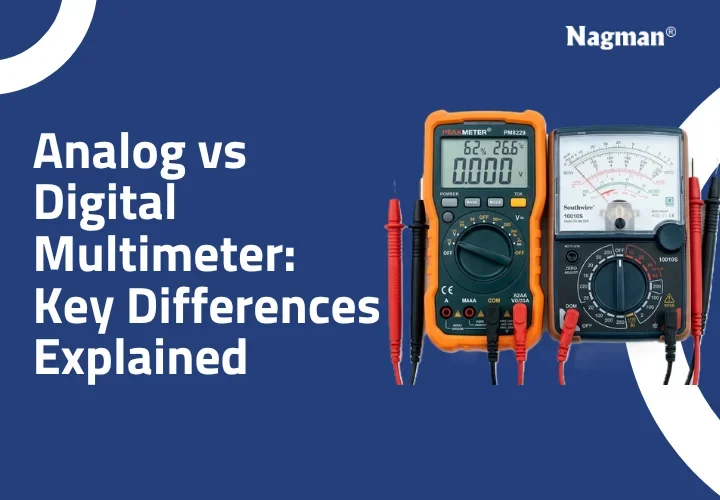
One of the most critical instruments in electrical and electronic work is a multimeter, which measures voltage, current, and resistance with a single handheld device. With the increased need for accurate electrical diagnostics in industries and workshops, selecting between the two main types of multimeter available has become important for professionals at every level.
In this blog, we explore analog vs digital multimeters, exploring how they operate, their differences, and which type would work best in demanding industrial environments.
What Is an Analog Multimeter?
Analog multimeters are a traditional measuring tool that uses a needle and a calibrated scale to display readings. The needle moves across the scale in direct proportion to the amount of electricity being measured, and the user must interpret the reading manually.
Let’s see what defines analog multimeters:
It works on the principle of a moving-coil galvanometer, in which the current passing through a coil in a magnetic field causes the needle to deflect.
The moving needle in analog multimeters is useful because it shows fluctuating readings and trends in real time, as the needle movement itself represents gradual changes in the signal.
These devices are also generally easier to manufacture and don’t need batteries for basic resistance and voltage readings, making them useful in certain field applications.
What Is a Digital Multimeter?
Digital multimeters are modern measuring device that converts electrical signals into numbers for display, eliminating the need to read the scale manually. Its usability and accuracy have made it the preferred option in most technical fields.
Let’s take a look at the reasons digital multimeters are so popular:
They use an analogue-to-digital converter to convert the input signal to a digital value that is then displayed on an LCD or LED display.
Most digital multimeters come with additional features like auto-ranging, data hold, continuity buzzers, and true RMS measurement that make testing much easier.
Readings are much less likely to be wrongly interpreted by the user as the reading is displayed directly instead of depending on the position of the needle.
Key Differences Between Analog and Digital Multimeters
When using a multimeter, it is important to know the difference between analog and digital multimeter types to choose the suitable tool for your specific application.
The key differences are outlined below:
Digital multimeters display precise numeric results on a screen while analog multimeters display them using a moving needle.
Digital devices are generally more accurate since there is no parallax error – and the risk of misreading a scale is minimised.
Analog multimeters are more useful for measuring trends or fluctuations, such as a slowly charging capacitor, whereas digital multimeters are more useful for measuring a stable, exact value.
While analog designs usually come with overload protection, auto power-off, and expanded range measurement, these features are rarely found in digital multimeters.
Which Multimeter Is Better for Industrial Applications?
Most manufacturers today opt for digital multimeters when choosing an industrial multimeter because of the requirements of modern equipment and safety measures.
Here is why digital multimeters are preferred in industrial settings:
In industrial applications, fast decision-making during maintenance or troubleshooting is needed, often requiring quick, unambiguous readings.
Many digital multimeters come with data logging and connectivity, enabling them to record and share readings for predictive maintenance programmes.
Analog multimeters are also important in certain niche applications, where the ability to monitor the trend is more valuable than a precise reading.
Frequently Asked Questions
- What is the difference between analog and digital multimeters?
Analog multimeters use a needle and scale that display readings, while digital meters display numeric values on a screen, making it easier to interpret. - Which multimeter is more accurate?
Digital multimeters are usually more accurate, eliminate the risk of incorrectly reading a dial, and deliver numerical readings with greater precision. - Why do industries prefer digital multimeters?
Digital multimeters are fast, reliable, and come with additional safety features and the capability to integrate with today’s maintenance and monitoring systems, making them the industry’s preferred choice.
Conclusion
Deciding between an analog vs digital multimeter ultimately depends on the requirements of the task at hand.
Reach out to our team today to learn more about the best multimeter solutions for your particular application needs.