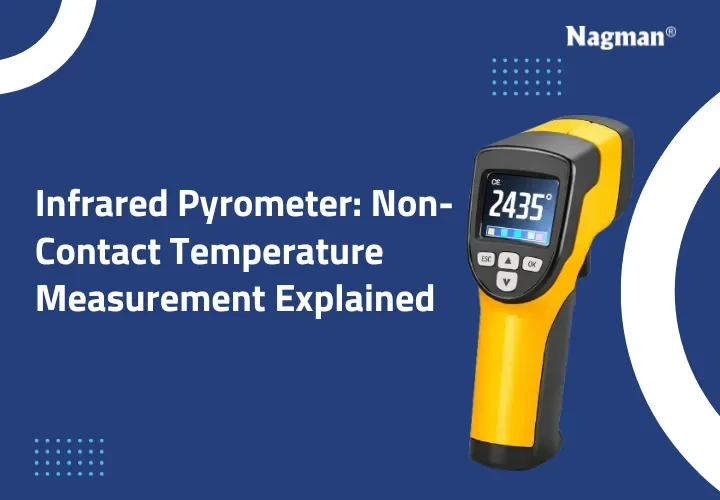
Infrared pyrometers are non-contact temperature measuring instruments that determine temperature by detecting infrared radiation emitted from an object. They are widely used in industrial environments where direct contact temperature measurement is unsafe, impractical, or impossible. Compared to traditional sensors, pyrometers provide fast, accurate, and reliable temperature readings for high-temperature applications.
Industries such as metal processing, glass manufacturing, cement plants, power generation, and furnaces depend on pyrometers to maintain process control and safety. Manufacturers like Nagman Instruments offer advanced pyrometers designed for demanding industrial conditions.
What Is Pyrometers?
Pyrometers are temperature measurement devices used to measure high temperatures without physically touching the object being measured. Unlike contact-based sensors such as thermocouples, pyrometers rely on thermal radiation emitted from a hot surface.
Pyrometers are especially useful when:
The object is moving
The temperature is extremely high
Contact sensors may damage the surface
Fast response time is required
How Do Pyrometers Work?
Pyrometers work by sensing the electromagnetic radiation emitted by an object. As temperature increases, the intensity of radiation also increases. The pyrometer detects this radiation and converts it into an electrical signal, which is then translated into a temperature reading.
In the case of infrared pyrometers, only infrared wavelengths are detected, allowing accurate non-contact temperature measurement even from a distance.
Types of Pyrometers Used in Industries
Although all pyrometers operate on radiation-based principles, they are categorized based on measurement technique.
Optical Pyrometers
Optical pyrometers measure temperature by visually comparing the brightness of a heated object with a calibrated light source. These are commonly used for extremely high-temperature applications such as molten metals.
Radiation Pyrometers
Radiation pyrometers measure total radiation energy emitted from an object over a wide wavelength range. They are suitable for continuous temperature monitoring in industrial processes.
Infrared Pyrometers
Infrared pyrometers are the most widely used type today. They detect infrared radiation and provide fast, accurate readings. These pyrometers are compact, easy to use, and ideal for automated and handheld applications.
Why Infrared Pyrometers Are Widely Used
Infrared pyrometers have become popular across industries due to their versatility and safety advantages.
Key benefits include:
Non-contact temperature measurement
Fast response time
Suitable for moving or rotating objects
Reduced risk of sensor damage
Improved operator safety
Because of these advantages, infrared pyrometers are commonly used in furnaces, kilns, heat treatment processes, and quality control applications.
Industrial Applications of Pyrometers
Pyrometers play a crucial role in maintaining temperature accuracy across various sectors:
Metal and steel industries
Glass and ceramic manufacturing
Cement and power plants
Automotive and aerospace production
Research laboratories
Accurate temperature measurement helps improve product quality, energy efficiency, and process safety.
Importance of Calibration for Pyrometers
Like all measuring instruments, pyrometers require periodic calibration to maintain accuracy. Calibration ensures that the pyrometer readings match traceable reference standards.
Regular calibration:
Improves measurement reliability
Reduces process errors
Ensures compliance with quality standards
Extends instrument life
Nagman Instruments provides reliable solutions and support for accurate temperature measurement and calibration requirements.
Choosing the Right Infrared Pyrometer
When selecting an infrared pyrometer, industries should consider:
Temperature range
Accuracy and resolution
Distance-to-spot ratio
Response time
Environmental conditions
Integration with control systems
Choosing the correct model ensures consistent performance and long-term reliability.
Future of Pyrometers in Industry
With Industry 4.0 and automation, pyrometers are evolving with digital outputs, data logging, and system integration capabilities. Smart infrared pyrometers now support real-time monitoring and predictive maintenance, helping industries optimize operations.
As non-contact measurement becomes increasingly important, pyrometers will continue to play a critical role in modern industrial environments.
Conclusion
Pyrometers, especially infrared pyrometers, are essential tools for accurate non-contact temperature measurement in high-temperature applications. By understanding how pyrometers work and selecting the right instrument, industries can improve safety, efficiency, and process control. With advanced solutions from Nagman Instruments, organizations can confidently meet their industrial temperature measurement needs.