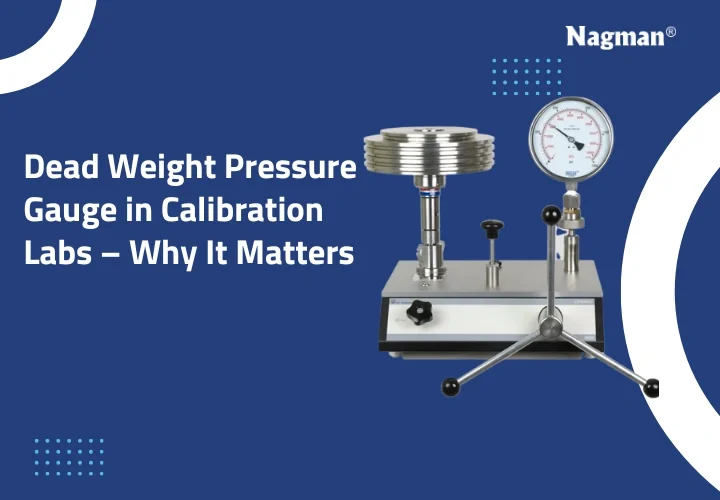
Introduction – Understanding the Dead Weight Pressure Gauge
The calibration laboratories prioritise precision. Even a minor pressure error can affect machines, safety systems, and the quality of the final product. The Dead Weight Pressure Gauge is extremely significant in this scenario. With its high accuracy and straightforward operating principle, it is a common choice in calibration labs across various industries.
Dead Weight Pressure Gauge – Definition & Importance in Calibration
A Dead Weight Pressure Gauge is a high-performance device that is used to measure and calibrate pressure instruments. It creates a very dependable pressure by placing known weights on a piston. The pressure created is accurate since the weights and the piston area are known.
In the calibration laboratories, this device is treated as a reference standard. It does not rely on electronic signals, thereby offering long-term stability and reliability.
A Dead Weight Pressure Gauge Is Used For Which Applications?
A dead-weight pressure gauge is used for calibrate pressure gauges, pressure transmitters, and pressure sensors. It finds application in sectors such as oil & gas, pharmaceuticals, power generation, and manufacturing.
The calibration laboratories are also using it to maintain pressure standards and verify the pressure calibration tools that the other laboratories are equipped with. Due to its high accuracy, it is well-suited for both low- and high-pressure testing.
A Dead Weight Pressure Gauge Works On Which Principle?
A dead-weight pressure gauge works on a simple yet highly advanced physical principle. Pressure is defined as the force acting on a certain area. In this device, a force is generated by applying calibrated weights to a piston. The piston is being allowed to move freely inside a cylinder filled with oil or other fluids.
The force is exerted on the piston as the weights are being incremented. Consequently, pressure is generated in the system by this force. The pressure reading, thus obtained, is extremely accurate.
Dead Weight Tester – Construction, Components & Function
A dead weight tester has a very simple yet precise construction. The main components include a piston-cylinder assembly, a calibrated weights set, a pressure generation system, and a test port.
The piston and cylinder are machined to a very fine finish to minimise friction. Under pressure, the piston moves up and rotates with no resistance. This not only guarantees accurate pressure generation during calibration but also smooth operation.
Dead Weight Pressure Gauge Tester – Setup & Operation
A dead-weight pressure gauge tester is straightforward to set up but requires proper handling throughout the process. The apparatus being tested is connected to the tester. The liquid is filled into the system, and the air is released from the system.
Next, the weights are gradually placed on the piston. The piston is slightly rotated so that there is no friction. When the piston is balanced, the pressure is recorded, and the gauge reading is compared.
Dead Weight Pressure Gauge vs Other Pressure Calibration Methods
The Dead Weight Pressure Gauge is superior to electronic calibrators and digital pressure controllers in terms of accuracy and stability, which are the primary advantages. Electronic devices may drift over time, but dead weight systems are based on physical constants.
While digital techniques are quicker, dead weight testing is more reliable for reference calibration. As a result, many labs still consider it a primary standard.
Accuracy, Standards & Traceability in Dead Weight Testing
Dead weight testing is very accurate, sometimes providing an error of only 0.01%. Calibration laboratories use certified weights linked to national or international standards, which can be traced back.
This tracing back provides assurance that all pressure measurements will be accepted and are thus reliable across all industries. Regular cleaning and calibration of the dead weight tester are some of the means to maintain accuracy.
Advantages of Using a Dead Weight Pressure Gauge
A Dead Weight Pressure Gauge’s main benefit is its exceptional accuracy. It is stable, repeatable, and does not require electricity. Besides, it has a long lifespan and requires little maintenance.
These advantages have made it an indispensable tool in calibration laboratories.
Conclusion – Why Dead Weight Pressure Gauges Are Essential in Calibration Laboratories
Dead Weight Pressure Gauges are widely used in pressure calibration and help measure the pressure at a specific point in the system or process with the same accuracy. The reason is not only due to its simple working principle, but also its high accuracy and strong reliability. Even modern digital tools are incapable of high-quality calibration, and this makes dead weight testing a leader in pressure measurement.