Pressure gauge calibration is an essential quality control process required to maintain meaningful and consistent readings from pressure-measuring devices across industries. Gauges that drift out of tolerance, even by a small margin, can lead to severe consequences such as breakdowns, safety risks, and equipment downtime.
This blog discusses the process of pressure gauge calibration, the importance of precision, the significance of instrument calibration, common mistakes, and the best practices for people working in the industry to achieve consistent and reliable measurement performance.
Why Pressure Calibration Is Critical in Industrial Operations
Most industrial applications depend on accurate pressure measurement. It can be boiler pressure monitoring or hydraulic systems, or sterile processing used in pharmaceutical units; each of these processes depends on correct readings.
Here is why it is essential to regularly calibrate pressure gauges:
- It guarantees the safety of operating conditions by avoiding incidents with overpressure or pressure loss.
- It ensures that the product quality is maintained by supporting precise process control.
- It reduces equipment wear and lessens repair costs.
- It promotes compliance with regulations and enhances audit preparations.
- It enhances the efficiency of operations by minimising measurement uncertainty.
Understanding Pressure Gauge Calibration – Step-by-Step Process
Instrument calibration usually follows the following steps:
- Initial inspection: The gauge is checked visually for damage, corrosion, dust, loose fittings, or dial misalignment.
- Zero check: The pointer is checked at zero with no pressure applied to the pointer to determine the starting accuracy.
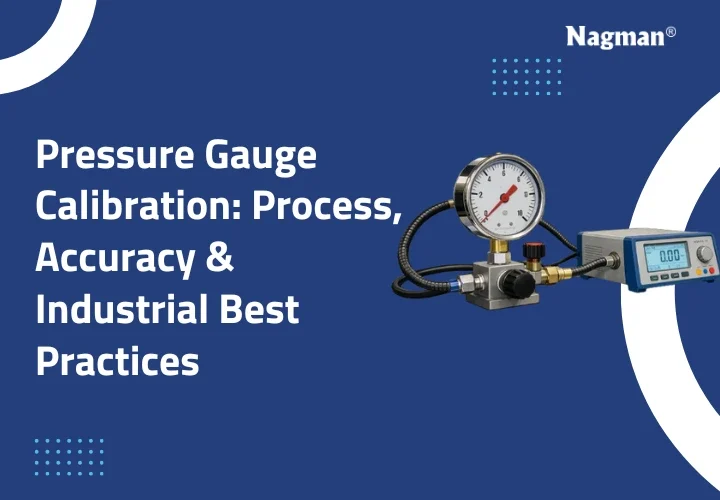
- Connecting with calibration devices: Both the gauge and the calibration device are connected.
- Using values of known pressure: It is done by increasing and reducing pressure in steps. The result of the gauge being tested is compared to the reference device.
- Recording deviations: All variations in the actual and indicated pressure are noted.
- Adjustment (where necessary): If the gauge is out of tolerance, the technician adjusts it to restore accuracy.
- Final check: Once the test is adjusted, a full test cycle is repeated to ensure it is reliable and fit for use.
Role of Instrument Calibration in Ensuring Measurement Accuracy
The role of calibration in pressure systems involves:
- Eliminating systematic errors.
- Ensuring standardisation for a variety of measurement devices.
- Enhancing national and international traceability standards.
- Increasing the overall process reliability.
Tools Used in Pressure Gauge Calibration
The two most commonly used instruments are:
Pressure calibrators
Pressure calibrators generate very accurate pressure levels for comparison. They may be manual, pneumatic, hydraulic, or fully automated, depending on the industry’s needs. The devices serve as the reference standard and provide repeatable, stable pressure values during calibration.
Digital pressure indicator
A digital pressure indicator provides accurate digital readings and is usually used when high accuracy is required. It shows pressure in real time, and it can be easily compared to the gauge being tested. It is a popular reference instrument in most calibration laboratories because of its high resolution, low measurement uncertainty, and ease of use.
Common Calibration Errors and How to Avoid Them
Despite the controlled nature of calibration, some errors can influence its accuracy. These include:
- Using improper equipment or uncalibrated reference equipment.
- Temperature fluctuations during the testing.
- Mechanical wear or internal gauge damage.
- Poor quality sealing or leaks in the system.
- Wrong assembly or position.
- Over-pressurisation beyond the instrument limits.
Best Practices for Maintaining Calibration Accuracy
Best practices followed in industries to increase reliability include:
- Periodic calibration of pressure gauges at regular intervals based on usage.
- Using certified and traceable pressure calibrators and indicators.
- Storing gauges in places where they cannot be contaminated and damaged through mechanical means.
- Training technicians on proper calibration and documenting it.
- Excessive vibration, shock, or temperature changes should not be applied to gauges.
Industry Standards and Certification Requirements
Pressure gauge calibration activities should conform to international standards to ensure uniformity in measurements.
Common standards include:
- ISO 17025 for a calibration laboratory.
- ASME and ISO pressure gauge accuracy classifications.
- National metrology institutes’ traceability requirements.
- Industry-specific guidelines for oil and gas and chemical and pharmaceutical sectors.
Conclusion – Importance of Regular Pressure Gauge Calibration
With reliable instruments, adherence to standard calibration procedures, and compliance with industry standards, organisations can become much more efficient and minimise risks at work. Regular instrument calibration prevents equipment damage and ensures the overall reliability of processes, which is why it is one of the pillars of modern industrial practice.