Pressure measurement is crucial in ensuring that industrial systems across various sectors are safe, efficient, and accurate. From power plants to pharmaceutical manufacturing facilities, precise pressure readings are essential to maintaining quality standards and preventing system failures. In this blog, we discuss the principles of calibrating pressure, with a special emphasis on dead-weight testers.
Introduction to Pressure Calibration
Verifying and adjusting pressure-measuring instruments to determine their accuracy relative to known standards is called pressure calibration. Over time, pressure gauges and sensors may drift due to frequent use, environmental factors, or mechanical wear. Hence, regular calibration is necessary to maintain consistent performance, ensure regulatory compliance, and achieve reliable process control.
Among the other tools available, dead weight testing instruments are one of the most accurate, offering both accuracy and long-term stability, and are thus extremely important in laboratories and industrial calibration systems.
What Are Dead Weight Testers?
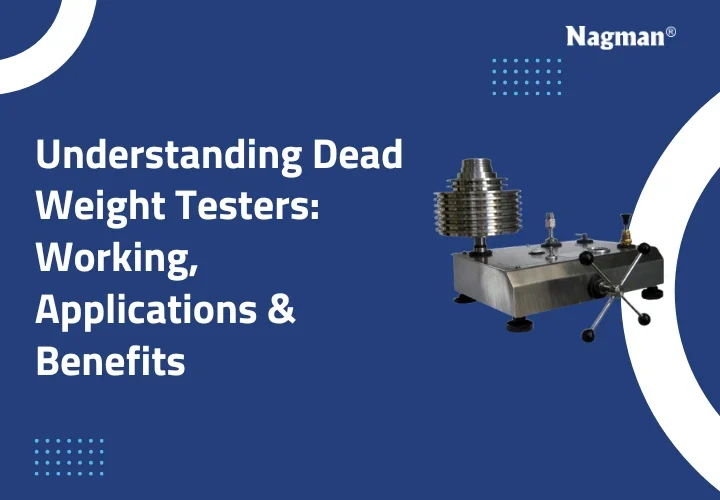
A dead-weight tester is the primary standard used for pressure calibration of pressure-measuring instruments. They work by generating an ultra-precise pressure by applying known weights to a precisely machined piston-cylinder assembly.
These devices are unparalleled in accuracy because fundamental physical principles determine pressure.
Working Principle – How Dead Weight Testers Operate
The working principle of a dead weight tester is based on the following equation:
Pressure = Force ÷ Area
Calibrated weights are placed on the top of a piston with a known effective area. Due to the force exerted by the weights, pressure is created in the system. This pressure is then exerted on the instrument being tested.
The piston is allowed to swing freely and minimise friction to evenly spread the pressure. Since the mass of the weights and the piston area are known accurately, the pressure generated is highly accurate and repeatable.
Dead Weight Testers in Instrument Calibration & Calibration Test Bench Setup
The dead weight tester is the fundamental element of a calibration test bench in professional calibration laboratories. They serve as the primary reference standards for checking the accuracy of working pressure instruments.
While calibrating instruments, the tester is attached to the object being tested, and incremental pressures are applied using calibrated weights. The readings from the instrument are compared to the known reference pressure. Any deviation is noted down and rectified accordingly.
Dead Weight Pressure Gauge vs Digital Pressure Indicator
Dead-weight pressure gauges provide pressure measurements based on mechanical principles, whereas digital pressure indicators use electronic sensors.
The advantages of a dead weight pressure gauge include better long-term stability and the absence of electronic drift. They can be used for reference-level calibration, which requires the highest degree of accuracy. Digital indicators are simple to use and give quick readings, but they must be recalibrated more often and are sensitive to environmental factors.
Dead Weight Testers vs Precision Pressure Controller
A precision pressure controller is a modern, automated device that electronically generates and controls pressure. Although these systems are effective and suitable for high-throughput settings, they remain secondary standards.
Dead-weight testing tools are primary standards, in contrast, and do not require initial calibration. They are also used to calibrate precision pressure controllers themselves.
Key Benefits of Dead Weight Testers
Here are some significant benefits of using a dead weight tester:
- Exceptionally high accuracy and repeatability.
- Primary standard, which is directly traceable.
- Long-term stability with minimal drift
- Simple mechanical build
- Ideal for laboratory and industrial pressure calibration.
- Suitable for a wide range of pressure points.
Industrial Applications (Oil & Gas, Power Plants, Pharma, etc.)
The key application areas of this device include:
- Oil and gas industry: Applied in the calibration of pressure instruments used in the drilling of oil wells, in refining processes, and in pipeline monitoring systems.
- Power plants: These are essential in maintaining safe and efficient boiler, turbine and steam pressure operations.
- Manufacturing units: Ensures reliable pressure measurements in production lines and quality control processes.
- Calibration laboratories: These are often used as part of a standard calibration test bench for high-accuracy instrument calibration.
Conclusion – Why Dead Weight Testers Remain the Gold Standard
Even after advanced digital solutions have been launched, deadweight testers remain the gold standard for calibrating pressure. They are unmatched in accuracy, reliability and traceability, making them essential in laboratories and in industries.