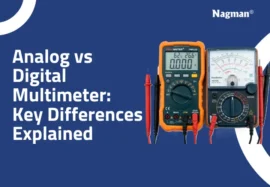
In any manufacturing or industrial setup, measurement accuracy plays a major role. Whether you monitor temperature, pressure, voltage, flow, or safety parameters, every value must be correct for production to run smoothly. With continuous operation, instruments gradually lose accuracy due to usage, aging components, and environmental exposure. To restore precision, industries rely on a calibration service, a process that brings instruments back to their true, defined values.
As one of the leading providers located in Chennai, Nagman Instruments helps industries standardize and correct devices such as gauges, indicators, analyzers, controllers, transmitters, and power supplies. This article explains what a calibration service means, how it is carried out, and why industries must perform it regularly.
What Is a Calibration Service?
A calibration service is a controlled procedure that checks whether an instrument is measuring correctly by comparing it with a high-accuracy reference standard. The reference has a certified value, and the difference between this value and the device reading indicates whether calibration is required.
If the device under test (DUT) shows an acceptable range of difference, it is cleared for continued use. If the deviation is beyond the tolerance limit, adjustments are required to bring it to the correct measurement.
A professional calibration process ensures:
Consistent results across repeated measurements
Reduced maintenance requirements
Better product quality and safety
Compliance with ISO and audit standards
How Is a Calibration Service Performed?
At Nagman Instruments, the procedure is carried out using traceable and documented steps. The most common approach is comparison against a reference:
Connect DUT and Standard
The DUT is connected to a certified reference instrument with superior accuracy.
Measure and Compare
The same value or signal is measured by both devices.
Calculate Deviation
The difference between readings shows how much the instrument has drifted.
Repeat Across Ranges
Multiple points across different ranges are tested to ensure full-scale validity.
Interpret Results & Adjust if Needed
If readings are outside tolerance, corrective adjustment or trimming is applied.
Alternative Procedure – Using CRM
In some cases, a Certified Reference Material (CRM) is used:
The CRM with a known value is measured
DUT takes the same reading
The difference is recorded
The process is repeated with additional samples
Results are interpreted
This method is commonly used when physical samples such as liquids, weights, or temperature blocks are needed.
Pass or Fail – Final Outcome
Once the data is captured and interpreted, the device is assigned one of two statuses:
Pass—measurement variation is within tolerance
Fail—readings exceed tolerance and correction or repair is required
Two accuracy-related metrics sometimes referenced include:
| Term | Meaning |
|---|---|
| TAR (Test Accuracy Ratio) | Reference standard accuracy compared to DUT |
| TUR (Test Uncertainty Ratio) | Difference between uncertainty of both instruments |
Nagman operates using a recommended minimum TAR/TUR ratio of 4:1, meaning the reference is at least four times more accurate.
Why Regular Calibration Is Important
Performing a calibration service periodically is essential because instruments:
Drift naturally with time
Are affected by humidity, heat, vibration or dust
Lose sensitivity due to internal wear
Must meet production audit and compliance requirements
Benefits of regular calibration include:
Maintaining product quality
Preventing costly breakdowns or rework
Keeping safety-critical readings reliable
Improving operational efficiency
Extending equipment life
Why Choose Nagman in Chennai
Nagman Instruments has over 50 years of industry leadership and serves clients across India and globally. In addition to calibration, Nagman also manufactures calibration benches and multifunction calibrators.
What sets Nagman apart:
NABL-accredited laboratory
On-site and laboratory-based calibration availability
Experienced engineers and trained technicians
Capability across thermal, electrical, dimensional, fluid-flow, and mechanical instruments
Corrective adjustment in addition to measurement testing
Whether the requirement is a refinery, a pharmaceutical facility, a food plant, automotive manufacturing, or HVAC system accuracy—Nagman provides solutions that match industrial expectations.
Where Calibration Is Used—Industry Examples
| Industry | Purpose |
|---|---|
| Pharma & Biotech | Temperature consistency in sterile rooms and autoclaves |
| HVAC | Accurate pressure and climate system control |
| Petrochemical | Safety-critical transmitter accuracy |
| Food & Beverage | Validated heat and flow monitoring |
| Power & Energy | Electrical system reliability |
| Manufacturing | Sensor, gauge and CNC accuracy |
Conclusion
A calibration service plays a crucial role in keeping production systems safe, efficient, and compliant. Without it, incorrect readings can lead to defective products, wasted material, downtime, and audit failure. By choosing a trusted provider like Nagman Instruments, industries benefit from skilled technicians, NABL-level accuracy, and long-term reliability.
If accuracy and operational control are priorities for your plant, scheduling a periodic calibration service is a smart and essential investment.