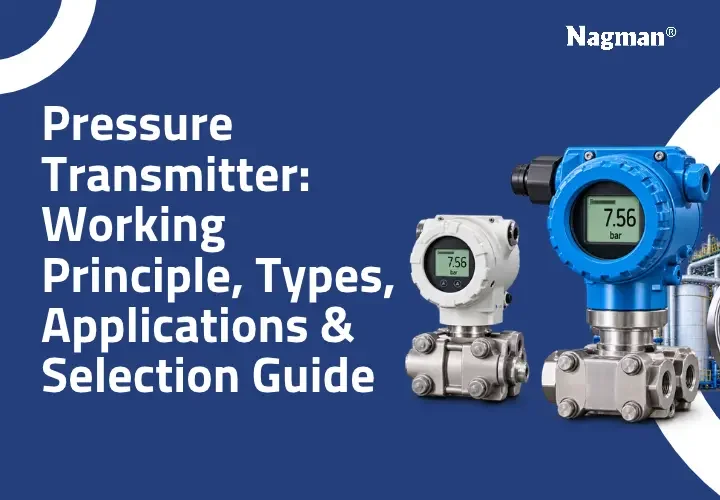
A pressure transmitter is an industrial measuring instrument that detects the pressure of liquids, gases or vapours and converts it into an electrical signal. This signal is transmitted to control systems such as PLC, DCS and SCADA for monitoring and process control.
Pressure measurement is essential in industries where maintaining accurate operating conditions is important for safety, product quality and equipment performance. Understanding the working principle, types and selection factors helps engineers choose the right instrument for different industrial applications.
What Is a Pressure Transmitter?
A pressure transmitter measures the pressure applied to its sensing element and converts the measurement into an electrical output signal. Common output signals include 4–20 mA, 0–10 V and digital communication protocols, depending on the instrument design.
These instruments are widely used in manufacturing plants, power generation, chemical processing, oil and gas facilities, and water treatment plants.
Unlike a basic pressure gauge, which displays pressure locally, a transmitter sends measurement data to a remote monitoring or control system.
How Does a Pressure Transmitter Work?
The pressure transmitter working principle is based on converting mechanical pressure into an electrical signal.
The process generally involves four stages:
- Pressure application: The process fluid applies pressure to the sensing element through the instrument’s pressure connection.
- Sensing: A sensing element, commonly based on piezoresistive, capacitive or strain-gauge technology, responds to the applied pressure.
- Signal conversion: The sensor’s electrical response is processed and converted into a proportional output signal.
- Signal transmission: The instrument sends the output to a monitoring or control system for display, recording or automated control.
For example, a 4–20 mA instrument configured for a specific pressure range produces an output proportional to the measured pressure.
What Are the Different Types of Pressure Transmitters?
The main types include gauge, absolute and differential instruments. Each measures pressure against a different reference.
1. Gauge Pressure Transmitter
A gauge pressure transmitter measures pressure relative to the surrounding atmospheric pressure. It is commonly used in pipelines, compressors, pumps and industrial process systems.
2. Absolute Pressure Transmitter
An absolute pressure transmitter measures pressure relative to a perfect vacuum. It is suitable for applications where atmospheric pressure variations must not affect the measurement reference.
3. Differential Pressure Transmitter
A differential pressure transmitter measures the difference between two pressure points. It is frequently used for filter monitoring, flow measurement and liquid-level measurement in closed tanks.
Selecting the correct type depends on the process requirements, pressure reference and operating conditions.
What Are the Industrial Applications?
Pressure transmitter applications cover several industries where continuous and reliable pressure monitoring is required.
Common applications include:
- Manufacturing: Monitoring pressure in production equipment and hydraulic systems.
- Power plants: Measuring pressure in steam, water and other process lines.
- Oil and gas: Monitoring pressure in pipelines, storage systems and processing units.
- Chemical industries: Maintaining pressure conditions in reactors and process vessels.
- Water treatment: Monitoring pressure in filtration and pumping systems.
- HVAC systems: Measuring air and fluid pressure in heating, ventilation and cooling equipment.
Choosing the correct instrument helps maintain process stability and supports operational safety.
Pressure Transmitter vs Pressure Transducer: What Is the Difference?
The pressure transmitter vs pressure transducer comparison mainly depends on signal conditioning and output requirements.
A pressure transducer generally converts applied pressure into an electrical signal, which may require additional signal conditioning. A transmitter typically includes signal-processing electronics and provides a standardised output suitable for industrial monitoring and control systems.
However, manufacturers sometimes use these terms differently. Always check the instrument’s specifications, output type and intended application before selection.
How to Select the Right Industrial Pressure Transmitter
Choosing an industrial pressure transmitter requires evaluating actual process conditions rather than selecting an instrument based only on its measuring range.
Consider these important factors:
- Pressure range: Select a suitable range based on normal operating pressure and expected maximum pressure.
- Pressure type: Identify whether the application requires gauge, absolute or differential measurement.
- Accuracy: Check the accuracy specification required for the process.
- Process connection: Ensure compatibility with the existing pipeline or equipment.
- Wetted material: Select materials compatible with the process fluid to minimise corrosion and damage.
- Operating conditions: Consider temperature, vibration, humidity and environmental conditions.
- Output signal: Confirm compatibility with the PLC, DCS or monitoring system.
The correct pressure transmitter selection helps improve measurement reliability and reduces the risk of incorrect readings or unnecessary instrument replacement.
Why Is Calibration Important?
Calibration verifies whether an instrument’s readings are within its specified accuracy limits. Over time, operating conditions, ageing and mechanical stress can affect measurement performance.
Pressure transmitter calibration involves comparing the instrument’s output against a traceable reference standard at selected pressure points. Any deviation is evaluated against the applicable accuracy requirements.
A suitable calibration setup may include a pressure controller or pressure calibrator, a reference pressure instrument and the required electrical measurement equipment.
For calibration professionals, selecting appropriate reference standards and following a documented calibration procedure are essential for obtaining reliable results.
Why Choose Nagman Instruments?
With a legacy dating back to 1972, Nagman Instruments has experience in calibration and test and measurement solutions for industrial applications. The company is ISO 9001:2015 certified and offers solutions across pressure, temperature and electrical calibration requirements.
For organisations involved in industrial measurement and instrument maintenance, choosing suitable calibration equipment and following reliable procedures are important steps towards maintaining measurement accuracy.
Contact Nagman Instruments to discuss your pressure calibration and industrial measurement requirements.
Frequently Asked Questions
1. What is the main purpose of a pressure transmitter?
Its main purpose is to measure the pressure of a process medium and convert it into an electrical signal for remote monitoring and process control.
2. What is the most common output signal?
A 4–20 mA output is widely used in industrial applications. Other analogue and digital outputs are also available depending on the instrument.
3. What is the difference between gauge and absolute pressure?
Gauge pressure is measured relative to atmospheric pressure, whereas absolute pressure is measured relative to a perfect vacuum.
4. How often should a pressure transmitter be calibrated?
Calibration frequency depends on the manufacturer’s recommendations, operating conditions, accuracy requirements, process criticality and applicable quality procedures. There is no single interval suitable for every application.
5. What equipment is used for calibration?
Depending on the instrument and required accuracy, calibration may involve a pressure calibrator or controller, a traceable reference standard and suitable electrical measurement equipment.
Conclusion
Understanding operating principles, measurement types, selection criteria and calibration requirements helps engineers make informed decisions about industrial pressure measurement. Proper instrument selection and periodic calibration support reliable readings, process efficiency and operational safety.
For pressure measurement and calibration-related requirements, Nagman Instruments brings decades of experience in industrial calibration and test and measurement solutions.