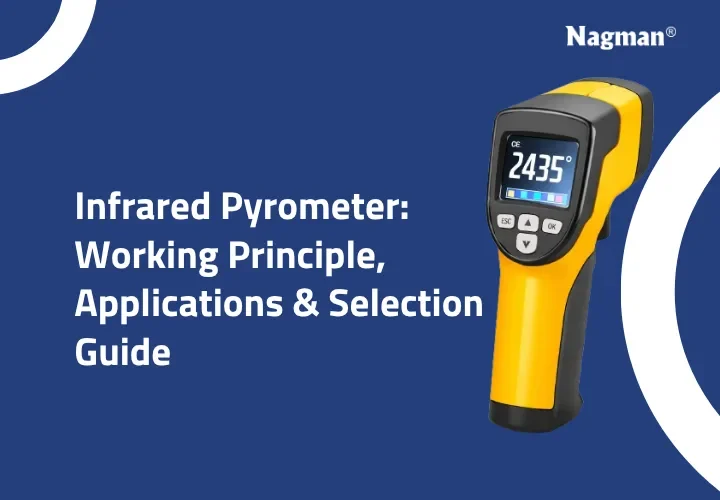
An infrared pyrometer is a non-contact temperature measuring instrument that detects infrared radiation emitted by an object’s surface and converts it into a temperature reading. It is useful in industrial processes where contact measurement is difficult, unsafe or unsuitable for hot and moving objects.
Choosing the right instrument depends on the target material, operating temperature, measurement distance, accuracy requirements and installation environment. This guide explains how infrared pyrometers work, where they are used and what industrial buyers should consider before selecting one.
What Is an Infrared Pyrometer?
An infrared pyrometer measures surface temperature without physically touching the target. It uses infrared radiation emitted by an object to estimate its temperature, making it suitable for applications where contact sensors may be impractical.
Depending on the model, these instruments can support manual temperature checks or continuous monitoring in industrial processes. A non contact infrared pyrometer is particularly useful when the target is extremely hot, continuously moving or difficult to access safely.
Infrared Pyrometer Working Principle
The infrared pyrometer working principle is based on detecting thermal radiation emitted by an object’s surface and processing that radiation to calculate its temperature.
The measurement process involves four steps:
- Radiation collection: The optical system collects infrared radiation from the target.
- Signal detection: The detector converts the received radiation into an electrical signal.
- Temperature calculation: The instrument processes the signal using its measurement model, calibration data and configured settings.
- Temperature display: The calculated temperature appears on the display or is transmitted to a monitoring system, depending on the model.
The pyrometer working principle relies on the relationship between thermal radiation and temperature. However, the reading can also be affected by surface emissivity, the instrument’s spectral response and measurement conditions.
For example, shiny metal and oxidised metal can emit radiation differently even at similar temperatures. Selecting an instrument suitable for the material and configuring it correctly helps improve measurement reliability.
Why Use a Non-Contact Pyrometer?
A non contact pyrometer offers several practical advantages in industrial temperature monitoring:
- Safer measurement: Measure suitable hot surfaces without direct physical contact.
- Fast response: Monitor temperature changes in processes that require quick readings.
- Moving-target measurement: Measure suitable moving or rotating objects when the instrument is correctly positioned.
- Reduced contact-related wear: Avoid direct contact between the instrument and the target.
- Process monitoring: Identify temperature variations that may affect product quality and production consistency.
Non-contact measurement is not automatically more accurate than contact measurement. Reliability depends on the instrument specifications, application and correct setup.
Infrared Pyrometer Temperature Range and Accuracy
The infrared pyrometer temperature range varies by model, detector, optical design and intended application. Always check the manufacturer’s specifications to confirm that the selected instrument covers the minimum, normal and maximum temperatures expected in your process.
Several factors influence measurement accuracy.
Emissivity and Surface Material
Emissivity describes how effectively a surface emits thermal radiation compared with an ideal emitter. Material type, surface finish, coatings and oxidation can affect emissivity. Incorrect settings may lead to inaccurate readings.
Distance-to-Spot Ratio
The distance-to-spot ratio describes the relationship between measurement distance and the diameter of the measured area. The target should adequately fill the measurement spot; otherwise, radiation from surrounding surfaces may influence the reading.
Target Size and Environmental Conditions
Dust, smoke, steam, hot surroundings and viewing-window materials can affect the radiation reaching the detector. Target size, alignment and spectral response should also be considered.
Before purchasing, verify the instrument’s specified temperature range, accuracy, response time and measurement geometry against your application requirements.
Industrial Applications of Infrared Pyrometers
Infrared pyrometers are used in industrial processes where surface temperature must be measured without direct contact.
Metal and Steel Processing
Suitable instruments can monitor heated metal during forging, rolling and heat-treatment operations. Temperature monitoring helps maintain consistent process conditions.
Glass Manufacturing
Infrared temperature measurement can support the monitoring of glass surfaces during heating and forming. The instrument must be suitable for the glass properties and measurement conditions.
Cement and Kiln Operations
In cement production, suitable instruments can help monitor selected hot surfaces and equipment, depending on the application and installation conditions.
Power Generation
These instruments can support temperature monitoring of selected equipment and process surfaces where non-contact measurement is appropriate.
Automotive Manufacturing
Infrared temperature measurement can support component monitoring during manufacturing and heat-treatment processes.
The correct model depends on the material, operating temperature, measurement distance and environment—not simply the industry in which it will be used.
How to Choose the Right Industrial Infrared Pyrometer
Choosing an industrial infrared pyrometer starts with defining the measurement requirement. A model with a high maximum temperature is not necessarily suitable for every application.
Evaluate these factors before requesting a quotation:
- Target material: Identify the material, surface finish and emissivity characteristics.
- Operating temperature: Determine the minimum, normal and maximum expected temperatures.
- Measurement distance: Confirm the distance-to-spot ratio and target dimensions.
- Accuracy requirements: Establish the temperature tolerance required by the process.
- Response time: Check how quickly the instrument must respond to temperature changes.
- Installation environment: Consider dust, vibration, ambient temperature and available mounting space.
- System integration: For automated processes, confirm the required analogue or digital outputs and control-system compatibility.
- Portable or online operation: Choose a portable instrument for manual checks or an online model for continuous monitoring, depending on operational needs.
Providing these details to an instrumentation supplier helps narrow the options and avoid selecting a model that does not meet the application’s requirements.
Importance of Calibration for Infrared Pyrometers
Calibration helps establish how an instrument’s readings compare with an appropriate reference under defined conditions. For an infrared pyrometer, calibration and periodic verification support measurement confidence and quality assurance.
The appropriate calibration interval depends on the instrument, operating conditions, measurement risk and applicable quality requirements. Follow the manufacturer’s recommendations and relevant quality procedures, particularly when readings influence critical production decisions.
If readings appear inconsistent, check emissivity settings, target alignment, measurement distance and environmental conditions as part of the troubleshooting process.
Why Choose Nagman Instruments?
Established in 1972, Nagman Instruments is an ISO 9001:2015 certified company with experience in temperature sensors, portable calibrators, calibration test benches and industrial test and measuring instruments.
Nagman represents overseas principals’ products, including online and portable infrared pyrometers, as part of its broader instrumentation portfolio.
For industrial buyers, identifying the measurement requirement is the first step towards selecting a suitable instrument. Target material, operating temperature, measurement distance, required accuracy and installation conditions should all be considered before choosing a model.
Looking for an Infrared Pyrometer for Your Application?
Discuss your industrial temperature measurement requirements with Nagman Instruments and enquire about suitable online or portable infrared pyrometers.
Contact Nagman Instruments to discuss your application and request product information.
Frequently Asked Questions
What is an infrared pyrometer used for?
An infrared pyrometer measures surface temperature without direct contact. It is used in suitable industrial applications such as metal processing, glass manufacturing, heat treatment and high-temperature process monitoring.
What is the working principle of an infrared pyrometer?
It detects infrared radiation emitted by an object’s surface, converts the received radiation into an electrical signal and processes that signal to calculate the surface temperature.
What is the difference between an IR pyrometer and an infrared pyrometer?
IR pyrometer and infrared pyrometer are two names for the same general type of instrument. Both refer to devices that use infrared radiation for non-contact temperature measurement.
What affects infrared pyrometer accuracy?
Emissivity, target size, measurement distance, spectral response, environmental conditions, instrument specifications and correct setup can all affect measurement accuracy.
How do I choose the correct infrared pyrometer temperature range?
Identify the expected minimum and maximum operating temperatures and select a model whose specified range covers the application. Also consider the target material, required accuracy, distance-to-spot ratio and environmental conditions.
Does an infrared pyrometer require calibration?
Calibration or verification helps establish confidence in temperature readings. The appropriate interval depends on the instrument, operating conditions, measurement risk and quality requirements.
Conclusion
An infrared pyrometer enables non-contact surface temperature measurement in industrial processes where contact-based measurement may be impractical. Reliable results depend on selecting suitable specifications, understanding measurement limitations and following appropriate calibration practices.
Nagman Instruments represents online and portable infrared pyrometers as part of its instrumentation portfolio. Contact Nagman Instruments to discuss your industrial temperature measurement requirements and enquire about a suitable solution.